Since 1980, Plymouth Housing has helped people who have experienced long-term homelessness rebuild their lives through stable housing combined with on-site support services. Today, Plymouth is one of the largest providers of this type of housing in the Pacific Northwest, offering homes, healing, and hope to nearly 1,500 residents across 18 buildings in King County. More than 360 staff members provide around-the-clock support, including front desk coverage, case management, group activities, and behavioral health and substance use services. Plymouth partnered with Bigger Boat to move its resident services work off of Agency, a legacy case management system, and onto a new Salesforce-based platform that Plymouth named Vantage. Agency has been decommissioned, and Plymouth’s resident services work now runs entirely on Salesforce.
Why Plymouth Moved Off Agency
Agency had served Plymouth for years, but it was holding the organization back in two important ways. The user interface was slow and dated, which added friction to every interaction staff had with the system across hundreds of users. And any meaningful customization required hiring an outside developer, which made it hard for Plymouth to keep the system in step with how its programs were evolving.
Plymouth wanted a platform that gave staff a fast, modern experience and gave the organization the ability to grow and adapt the system from the inside. With a dedicated internal Salesforce administrator, Plymouth could own its own roadmap rather than queue up changes with a third party.
Project Goals
As we do with all of our clients, Bigger Boat started with a discovery phase to develop a shared understanding of Plymouth’s challenges, programs, and goals. From that work, we agreed on the following goals:
- Decommission Agency. Move all resident services work onto a single, modern platform.
- Efficient workflows for key program needs. Build streamlined experiences for incidents, logs, FCS billing, case notes, “last seens,” and the other day-to-day activities that drive Plymouth’s work.
- A secure system designed around staff roles. Plymouth has many different roles — front desk staff, case managers, site directors, safety team, behavioral health, billing — and each role needs different information and different permissions.
- Intuitive to use. With 360 users across 18 buildings, the system needs to be easy to learn and easy to use day to day. Time spent in the system is time not spent with residents.
- Self-sufficiency. Plymouth’s internal team should be able to maintain and extend Vantage with minimal outside help.
- Data-centric programming. Equip leadership and staff with timely, trustworthy data to inform program decisions.
- Built to evolve. Plymouth’s programs and services will keep changing. The system needs to flex with them.
Guiding Principles
The project team agreed on a set of principles up front to keep decisions consistent throughout the build:
- Design for flexibility so the system can support organizational and program evolution over time.
- Build solutions Plymouth can support internally for the long term.
- Deliver core functionality first using standard Salesforce capabilities wherever possible, then iterate to expand and enhance.
- Break the work into discrete increments so implementation teams can stay focused.
- Involve key staff at the right moments. Test as we build.
These principles shaped everything from the release plan to which features got custom code and which used out-of-the-box capabilities.
Prioritization and a Phased Release Plan
Plymouth’s programs are complex, and so is the workflow choreography between Vantage, Yardi (Plymouth’s property management system), and the organization’s enterprise data warehouse. Trying to build everything at once would have been a recipe for delay and risk. Instead, we organized the work into a series of releases that delivered usable functionality early and layered in complexity over time:
- Core framework. Person accounts, buildings, units, the Plymouth Residence (occupancy) model, basic resident pages, and out-of-the-box search.
- Key day-to-day functionality. Logs, incidents, “last seens” and unit absence, group activities, occupancy enhancements.
- Bringing resident data together. Move-ins, assessments, resident notes, the v2 resident page, and a custom-built roster page.
- Case management and billing. Case notes, referrals, individual service plans (ISPs) with goals, FCS billing, grants, and program enrollments.
- Guests. Guest management, guest logic on person accounts, duplicate management, and a custom guest kiosk.
- Full integration test. End-to-end testing in a full test environment, with role-based pages and final training.
- Production rollout. Final data migration and a phased go-live, starting with one building and expanding from there.
This sequencing allowed Plymouth to start using parts of the system early, gather feedback, and adjust before later releases were locked in.
System Highlights
Role-Based, Action-Focused Home Pages
Front desk staff, case managers, site directors, and managers all have different jobs, so Vantage’s home pages are tailored to each role. Staff open the system to a list of what needs their attention rather than a generic dashboard. A case manager sees their open incident reviews, staff alerts, “last seen” watch lists, and case notes that need action, filtered to the residents they work with. Managers see the same items rolled up across the staff and properties they oversee.
This role-based approach runs throughout Vantage. The home page, resident page, and building page each surface different information depending on who is looking.
Resident Page Built Around Daily Work
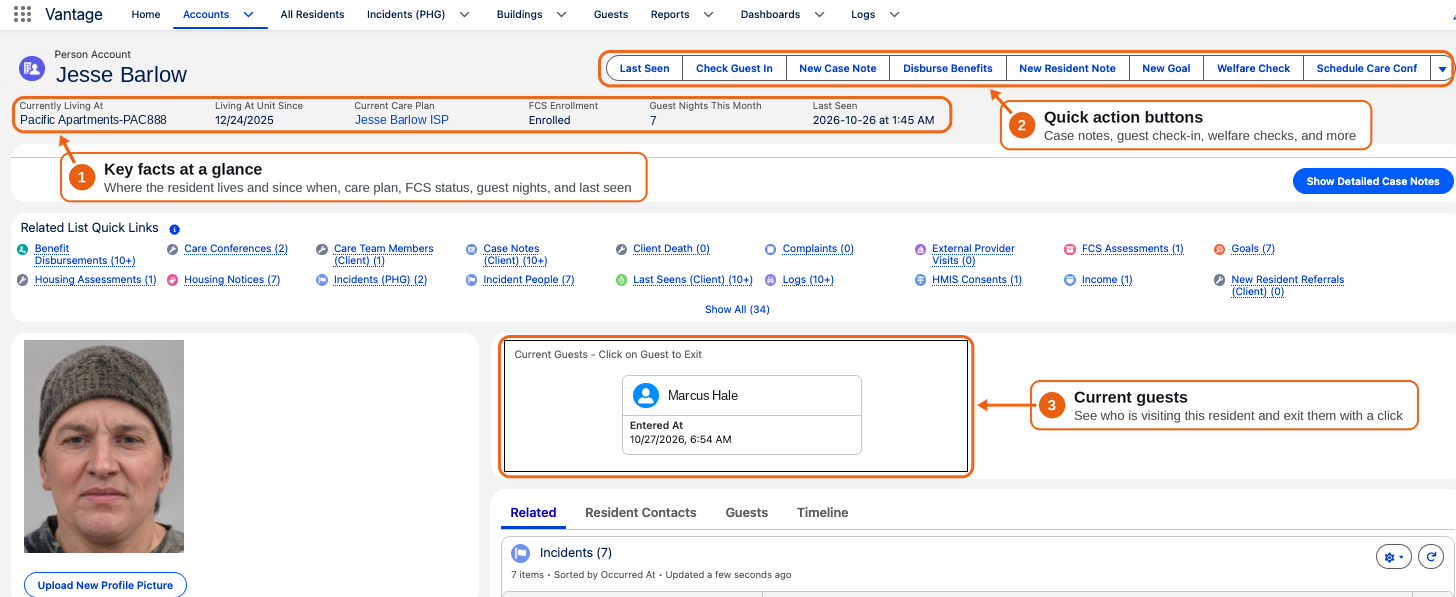
Most of a case manager’s day happens on the resident page, so we designed it around the actions they take. The header shows key facts at a glance: where the resident lives and since when, their current care plan, FCS enrollment status, guest nights this month, and when they were last seen.
Quick action buttons let staff record a “last seen,” check in a guest, write a case note, disburse benefits, add a resident note, set a goal, log a welfare check, or schedule a care conference without hunting through menus.
Below the header, quick links lead to all of the resident’s related records, from care plans and case notes to incidents, housing notices, and income. Resident notes and current guests are pinned in their own panels so they are always visible.
Building Pages for Building-Based Staff
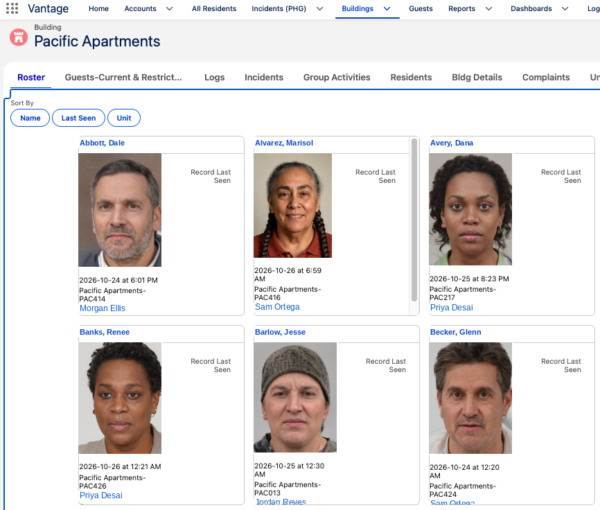
Many Plymouth staff work in a single building and think about their work in those terms: who lives here, who’s visiting, what happened on the last shift. Vantage’s building pages match that view with tabs for the roster, current guests, logs, incidents, group activities, residents, building details, and complaints.
The custom-built Roster page shows a card for every resident with their photo, unit, primary case manager, and “last seen” status. Staff can sort by name, “last seen,” or unit, and record a “last seen” with one click.
The Logs tab shows every shift log, cleaning, incident, and other building event with its author, time, and the residents and guests involved, so staff coming on shift can catch up quickly.
FCS Enrollment and Billing
In Washington State, Foundational Community Supports (FCS) is a Medicaid program that funds supportive housing services for eligible residents. It is a meaningful source of funding for Plymouth, and the process is intricate: residents must be enrolled and reauthorized on schedule, case notes must meet specific standards to be billable, and monthly billing must be accurate and timely. Vantage handles the full lifecycle.
Enrollment. Case managers enroll residents from the resident page. The enrollment record captures what the program requires (new authorization or reauthorization, status, authorized units, EPR approval date and notes, and authorization start and end dates), and supporting documents are attached directly to it.
Monthly billing. A dedicated FCS Billing app gives billing staff one workspace to prepare each month’s submission:
- Reviewers see all case notes for FCS-enrolled residents and mark each one billable or not directly from the list.
- A duplicate report flags multiple case notes for the same resident on the same day so the reviewer can choose which one to bill.
- Watchlists show enrollments ending in the next 30 days, enrollments awaiting approval, and enrollments with five or fewer authorized units left.
- Reports summarize billing units and active enrollments by building so leadership can track revenue and program health.
When the review is complete, staff export the FCS billing report as the file Plymouth submits to the state. The result is a billing process that catches errors before submission, with documentation behind every claim.
Other Key Features
- “Last seen” tracking. For residents with significant medical, behavioral health, and substance use needs, going unseen for several days can mean a welfare check is needed. Vantage tracks “last seen” activity for every resident and shows it with a color-coded indicator on the resident page. The same data drives watch lists on staff home pages.
- Incident management with role-specific approvals. Different types of incidents need review by different people, from case managers and site directors to the safety team. A flow-based approval process routes each incident to the right reviewers based on its type, and a Work Guide walks each reviewer through what’s needed to close it or send it back. The result is a clear, auditable record of how every incident was handled.
- Guest management. For resident safety, guests must check in and be verified before entering a building. A custom-built kiosk streamlines check-in and check-out, and current guests appear on both the building and resident pages so staff always know who is in the building. Behind the scenes, guest logic on person accounts manages duplicates, including guests who later become residents.
- Care teams, goals, and ISPs. Each resident’s care team, including their primary case manager and representative payee, appears on the resident page with each person’s role and start date. Case managers work with residents on individual service plans with goals tied to housing stability, health, income, and other outcomes, and goal status is visible on the resident page.
- Yardi and data warehouse integration. Yardi, Plymouth’s property management system, remains the source of truth for unit, occupancy, and rental data. Vantage receives that data through Plymouth’s enterprise data warehouse rather than a direct integration, which lets Plymouth change data flows without rebuilding integrations.
Decommissioning Agency
The end goal of the project was a clean handoff: all resident services work moves to Vantage, Agency goes away. Plymouth and Bigger Boat planned the rollout to make that handoff smooth. The first building went live first as a pilot, then the rest of the organization followed. After go-live, Agency stayed in read-only mode briefly so staff could reference historical records as they got comfortable with Vantage, and then it was decommissioned.
Today, Plymouth is fully on Salesforce for its resident services work.
Lessons for Other Supportive Housing Organizations
Plymouth’s project offers a few takeaways for other organizations considering a similar move, particularly those still on Agency or another legacy system:
- A modern UI matters more than feature parity at the start. Staff use the system every day. Speed and clarity have outsized effects on adoption and time spent on services.
- Phased releases beat big-bang launches. Putting working software in front of real users with real data early surfaces issues that no amount of design review will catch.
- Invest in an internal Salesforce administrator from day one. Plymouth’s ability to own and evolve Vantage long-term depends on having someone inside the organization who knows the system.
- Design for the work to be done, not for the org chart. A front desk worker, a case manager, and a director all need different things. Tailoring the experience to the staff member pays off in adoption.
- Approval workflows are worth the build. For high-stakes work like incident review, a structured approval process with role-based routing is far more reliable than email and verbal handoffs.
Plymouth Housing now has a platform that matches the ambition of its mission: a system that supports staff in real time, scales with the organization, and gives Plymouth the data it needs to keep helping people leave homelessness behind.